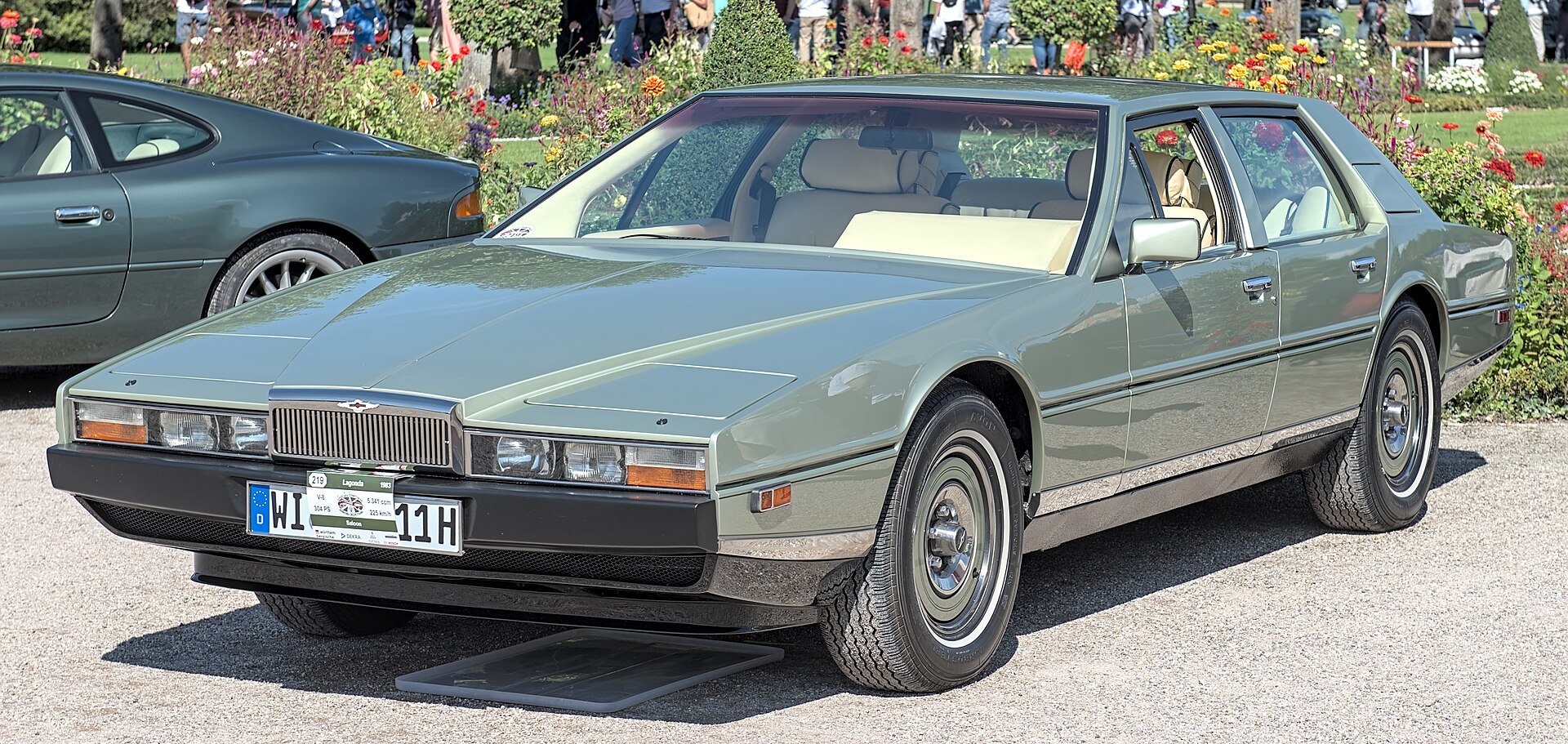
<p data-sourcepos="1:1-1:619"><span class="citation-49 citation-end-49">The Aston Martin Lagonda Series 2, introduced at the 1976 London Motor Show, marked a radical departure for the venerable British marque.</span> <span class="citation-48 citation-end-48">Following a short-lived Series 1, which was essentially a stretched Aston Martin V8, the Series 2 was a completely redesigned luxury saloon by William Towns, embodying the futuristic "folded paper" aesthetic prevalent in 1970s design.</span> <span class="citation-47 citation-end-47">Its sharp, angular lines and dramatic wedge shape were unlike anything Aston Martin had produced before, aiming to position the Lagonda as a technologically advanced statement in the luxury car market.</span></p>
<div class="source-inline-chip-container ng-star-inserted"></div>
<p data-sourcepos="3:1-3:664"><span class="citation-46 citation-end-46">Underneath its striking exterior, the Lagonda Series 2 utilized Aston Martin's familiar 5.3-liter DOHC V8 engine, producing around 280 horsepower and 302 lb-ft of torque.</span> <span class="citation-45 citation-end-45">While not intended as an outright sports car, this powerplant, often mated to a 3-speed Chrysler Torqueflite automatic transmission, provided ample power for refined cruising and could propel the large saloon to a top speed of approximately 143 mph.</span> The engine's placement far back in the chassis contributed to a more balanced weight distribution, and despite its size, the Lagonda was noted for its surprisingly competent handling for a luxury sedan of its era.</p>
<div class="source-inline-chip-container ng-star-inserted"></div>
<p data-sourcepos="5:1-5:707"><span class="citation-44 citation-end-44">Perhaps the most distinctive and ambitious feature of the Lagonda Series 2 was its interior, which embraced cutting-edge (for the time) digital instrumentation and touch-sensitive controls.</span> Early models featured a fully digital LCD dashboard, later evolving to a triple Cathode Ray Tube (CRT) display with a synthesized voice alerting the driver to various vehicle conditions. This revolutionary technology, while often prone to unreliability in early production, truly set the Lagonda apart from its more conventional rivals. <span class="citation-43 citation-end-43">The cabin itself was a luxurious blend of traditional Aston Martin craftsmanship, with rich leather and wood contrasting with the futuristic displays.</span></p>
<div class="source-inline-chip-container ng-star-inserted"></div>
<p data-sourcepos="7:1-7:592">The Lagonda Series 2 was a high-risk, high-reward venture for Aston Martin. Its bold design and pioneering technology were intended to re-establish the company's innovative spirit after financial difficulties. Production commenced slowly, with deliveries beginning in 1979, and a mere 645 units of all Lagonda series were built between 1974 and 1990. Despite its technical challenges and high price tag, the Lagonda Series 2 remains a unique and iconic piece of automotive history, a testament to Aston Martin's willingness to push boundaries and create a truly distinctive luxury automobile.</p>
Read more