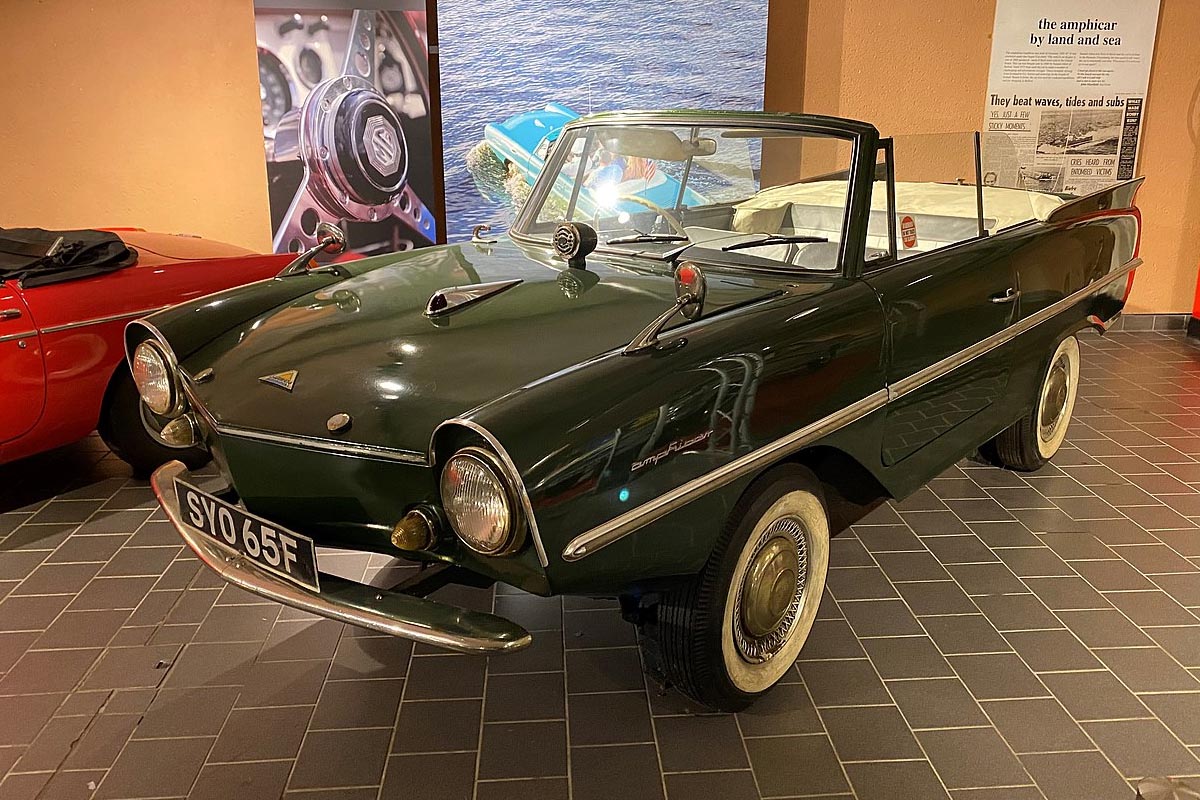
Unveiled with a splash at the 1961 New York Auto Show, the Amphicar Model 770 is an engineering marvel that captured imaginations worldwide. Birthed in the factories of West Germany and marketed until 1968, this amphibious vehicle redefined versatility in automotive design. Although production ceased in 1965, it had a remarkable run with 3,878 units being crafted in a single generation. The name Amphicar is ingeniously coined, a fusion of "amphibious" and "car," capturing the essence of its dual functionality.
The brainchild of Hans Trippel, the car was manufactured by the Quandt Group at facilities in Lübeck and Berlin-Borsigwalde. Touted as a spiritual descendant of the Volkswagen Schwimmwagen and the Trippel SG6, the Amphicar may not have been a high-performance vehicle by conventional standards, but it was an icon of fun and adventure. A detailed inspection revealed it to be a product of intricate engineering. The vehicle's engine was a Triumph four-cylinder engine of 1147 cc, boasting a modest yet sufficient power output of 43 horsepower. With an 8:1 compression ratio, this engine was connected to a four-speed manual transmission that drove the rear wheels on land and a pair of reversible propellers in the water.
What sets the Amphicar apart is its unique chassis and body design. Measuring 14.250 feet in length and 5.083 feet in width, the vehicle stands notably high above the ground. The body of the Amphicar is composed of mild steel and is designed to be robust yet lightweight, tipping the scales at an empty weight of 2,315 pounds. The front undersurface is slightly pointed, and the wheels are strategically set low, enabling the car to easily transition from land to water. Navigational lights and a flag, as mandated by the US Coast Guard, were also integrated into the design, following stringent safety protocols.
Water propulsion is facilitated by twin propellers mounted under the rear bumper. A second gear lever is engaged for forward or reverse drive in the water, making it both a car and a boat. While its performance may not break records, with top speeds of 7 knots in water and 70 mph on land, the Amphicar was loved for its spirit of adventure.
This vehicle's significance is not just limited to its engineering feats; it has a rich history and cultural impact as well. From successfully navigating the Yukon River in Alaska to crossing the English Channel, the Amphicar has had its share of adventures. Notably, four Amphicars participated in the 1967 Yukon River Flotilla, a journey covering 460 miles. This amphibious automobile has even found its way into popular culture, appearing in multiple films and television shows.
Owned by personalities like US President Lyndon B. Johnson and featured in numerous events, the Amphicar is a symbol of ingenuity and the joy of unconventional driving. With an enthusiastic community of owners convening for "swim-ins" and even a feature at Walt Disney World's Disney Springs, the Amphicar has carved out a unique niche for itself in automotive history. A fascinating blend of novelty, engineering, and audacity, the Amphicar Model 770 remains a beloved classic that continues to float—quite literally—in the annals of automotive lore.