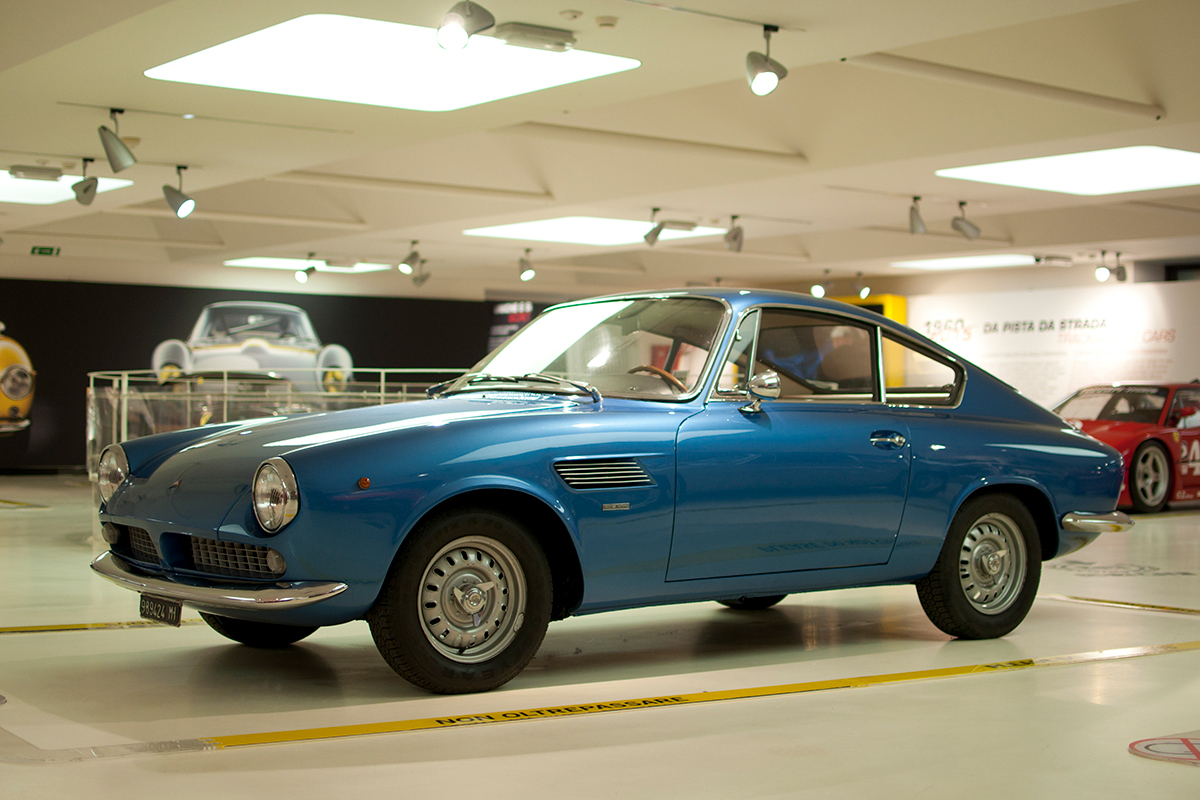
In the annals of automotive history, ASA (Autocostruzioni Società per Azioni) stands as a brand that aimed to bring a slice of Ferrari engineering to the masses, albeit for a brief period between 1961 and 1969. Originating from a daring experiment by Ferrari engineers in the late 1950s, the brand's flagship model, the ASA 1000 GT, was conceived as a more affordable and compact counterpart to Ferrari's existing GT cars.
The blueprint of this car was meticulously crafted by some of the most distinguished names in automotive design and engineering. Gioacchino Colombo, known for his groundbreaking "250" 3-litre V12, contributed by creating inline-four and straight-six engines for ASA. Giotto Bizzarrini, another maestro in the field, played a crucial role in developing the car's chassis, which was evolved from the iconic tubular frame of the Ferrari 250 GTO.
Originally presented as a prototype by Carrozzeria Bertone under the name "Mille" at Geneva in 1961, the car caught the attention of none other than Enzo Ferrari. However, due to factory limitations and other constraints, Enzo Ferrari decided against selling the car under the Ferrari brand name. Instead, production was entrusted to Oronzio de Nora, a close friend and business associate. Under de Nora's leadership and the auspices of the De Nora Electrochemical Group, ASA was formed, and manufacturing operations were set up in Milan.
Following its official introduction in 1962, the ASA 1000 GT finally entered series production in 1964. It was powered by the Tipo 141 I4 engine, which boasted an impressive 91 horsepower at 6800 rpm. Designed with a tubular spaceframe chassis and equipped with state-of-the-art suspension and braking systems, the car weighed just 1,720 pounds. Despite its impeccable engineering and driving dynamics, the ASA 1000 GT struggled to gain traction in the market, mainly due to its high retail price and the brand's limited name recognition.
Beyond the 1000 GT, ASA ventured into the realm of competition cars. Notable among them was the ASA 1000 GTC, a sports racing car that was lighter and more agile than its road-going counterpart. The brand also dabbled in larger displacement vehicles and even produced a few models with fiberglass bodies, further diversifying their portfolio.
Despite its best efforts and an anticipated annual production volume of 3,000 to 5,000 cars, ASA could never realize its full potential. Total production figures remain ambiguous but are estimated to be less than 100 across all models. By 1967, the factory was officially closed, although some cars continued to be assembled from spare parts and sold as new until the early 1970s.