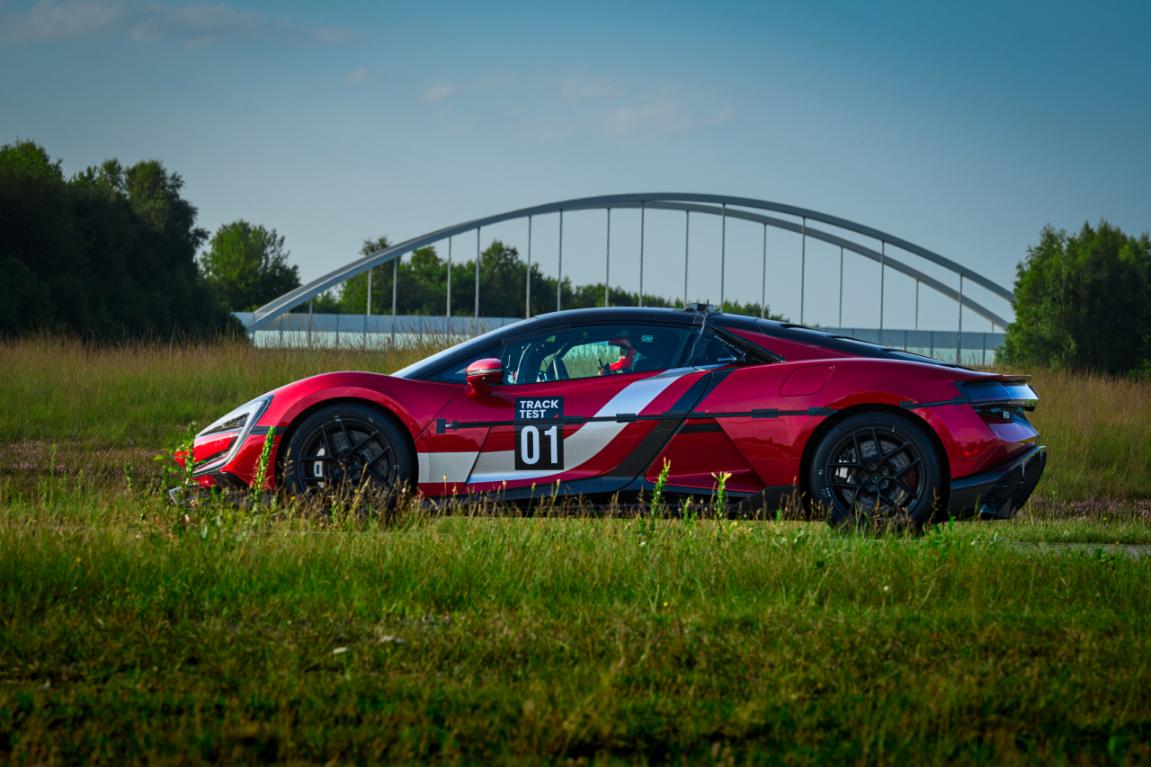
The automotive world has a new speed king and it doesn’t come from Italy, Germany, or France. BYD’s Yangwang U9 Track Edition, a Chinese-built hypercar, has just clocked 472.41 km/h (293.6 mph), officially setting a new global top-speed record for an electric production car. The feat dethrones long-standing icons and marks a seismic shift in the global performance car hierarchy.
This blistering run was verified at the Papenburg high-speed test track in Germany, where the U9’s performance stunned engineers and spectators alike. For context, this number not only surpasses previous electric records, it even challenges the likes of Bugatti and Koenigsegg in the combustion-engine world.
The Car Behind the Record
The Yangwang U9 is no ordinary EV. It’s a carbon-bodied hypercar built with BYD’s cutting-edge e⁴ platform, featuring quad motors delivering a combined 1,287 horsepower and torque distribution so precise it can spin in place like a tank.
Key highlights of the U9 Track Edition:
Top speed: 472.41 km/h (new EV record)
Power: 1,287 hp from four electric motors
0–100 km/h: ~2 seconds (claimed)
Chassis: Lightweight carbon-fiber monocoque
Battery tech: BYD’s proprietary Blade battery system
This isn’t just a showpiece either—the U9 is a production-ready car that BYD intends to deliver, unlike some hypercar concepts that never make it to the road.
More Than Just Numbers
BYD’s achievement isn’t just about building a fast car. It represents a symbolic milestone: Chinese automakers are now leading not only in mass-market EVs, but also at the absolute pinnacle of performance.
For years, names like Tesla, Rimac, and Bugatti have dominated the EV and hypercar conversation. Now, BYD has firmly planted its flag at the top. This is more than a flex of horsepower—it’s a statement that China’s automotive industry is ready to challenge legacy brands on their home turf.
As BYD put it during the record attempt, the U9 “combines extreme speed with extreme control.” With torque vectoring at each wheel and advanced aerodynamics, the hypercar isn’t just built for straight-line runs—it’s engineered for track dominance too.
How It Stacks Up Against Legends
The Yangwang U9’s 472.41 km/h run puts it ahead of:
Rimac Nevera – previously the fastest EV at 412 km/h
Tesla Roadster (claimed) – yet to prove its promised top speeds
Bugatti Chiron Super Sport 300+ – 490 km/h, but combustion-powered
While Bugatti still holds the ultimate road car record at 490 km/h, the fact that a Chinese EV is knocking on the door of such giants is groundbreaking.
A Future of Hyper-EV's
The Yangwang U9 Track Edition is more than just a headline-grabber. It represents a future where electric hypercars are no longer seen as novelties, but as the new standard for ultimate performance. With instant torque, innovative battery technology, and advanced aerodynamics, EVs like the U9 are rewriting the rulebook.
What’s next? Rumors suggest BYD could take the U9 to Nürburgring to prove it can dominate not just in straight-line speed, but also in handling and endurance. If successful, it would silence any remaining critics who claim electric hypercars lack the soul—or stamina—of their petrol-powered rivals.
Final Thoughts
The BYD Yangwang U9 Track Edition is now the world’s fastest production EV, and perhaps more importantly, a symbol of how quickly the balance of power in the automotive world is shifting. For decades, European brands held the crown. Today, a Chinese hypercar has proven that the future of speed, luxury, and performance might just belong to electric power.

